
After many years of quiet work, reflection, and testing solutions born out of personal need, the time has come for my voice to be heard in public.
I’m grateful to the editorial team at Newsmax Balkans for recognizing the importance and uniqueness of the topics I work on, and for inviting me to share my story.
From everyday tech solutions that make life easier, to the TURNIO system for turning in bed. Everything I develop has one goal: more dignity, more independence, and less suffering for people living with severe physical disabilities.
You can read my first interview here, and for me, it means much more than just being published. Perhaps this very article will spark a new direction or meaningful connections.
The original article is published in Serbian on the Newsmax Balkans website, but you can find the full English translation below.
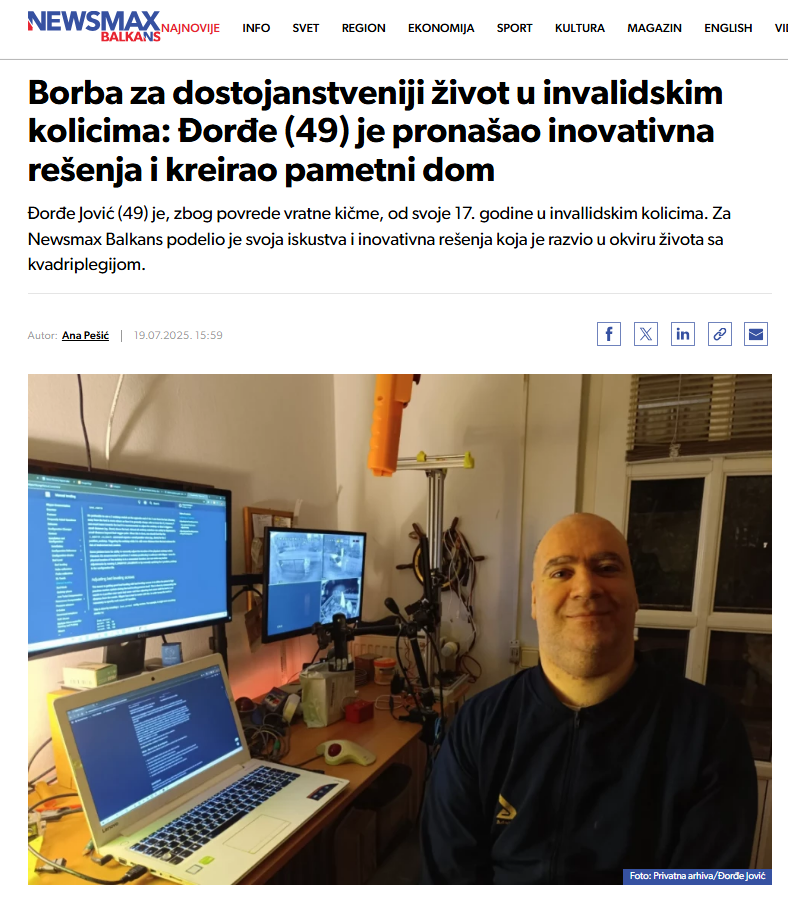
Fighting for a More Dignified Life in a Wheelchair: Đorđe (49) Found Innovative Solutions and Created a Smart Home
Đorđe Jović (49) has been using a wheelchair since the age of 17 due to a spinal cord injury in the cervical region. In this interview with Newsmax Balkans, he shares his experiences and the innovative solutions he has developed while living with quadriplegia.
In an interview with Newsmax Balkans, Đorđe explained that he ended up in a wheelchair as a teenager after a motorcycle accident caused a spinal cord injury.
He emphasized that the injury completely transformed his life.
“I don’t really count the years anymore, this kind of life is measured differently. It’s a catastrophic injury that changes your life to the core. It affects not just you, but your entire family and everyone around you. It takes many years to mentally accept your condition and new circumstances, and to start living life in a way that’s imposed on you, something no one can train or prepare you for,” Đorđe told us.
“Facing this level of powerlessness forces you to grow up overnight”
He described the wide range of health problems that come with this type of injury, symptoms and signals from the body that you can no longer feel due to paralysis.
“You have to learn to live with all of that. Countless personal, physical, architectural, and social barriers… misunderstanding, being ignored. Facing so much helplessness and so many obstacles forces you to grow up overnight. There’s no heroism in it, contrary to what some people might superficially assume. A huge part of this kind of life is sheer misery and suffering,” Đorđe pointed out.
He began finding solutions when he realized what he needed didn’t exist
Technology, he says, has made his life and daily functioning significantly easier.
“I couldn’t survive without technology, neither old or new. I follow everything tech-related daily and constantly think about how something could be applied or adapted to my case. I use every piece of technology that makes even a tiny bit of life easier, for me and everyone around me. From a patient lift for getting out of bed, to good-quality wheelchairs, to a smart switch for turning on a lamp, and a modified van with a ramp…”
He added that, compared to the past, technology now truly saves and prolongs lives.
In his efforts to make life easier, Đorđe went a step further—he became an innovator himself.
“I started finding solutions when I realized that what I needed either didn’t exist or was far too expensive. Then you have no choice but to invent, adapt, or create something on your own. Each assistive device is a tool designed to solve a very specific problem—often a unique one. You can find a lot online, but for the truly specific things, you have to come up with your own solution,” Đorđe explained.
Đorđe’s “Smart Home”
In search of answers to specific problems, Đorđe gradually created a smart home tailored to his needs.
“The first thing we did—this was a long time ago—was install electric locks with switches wired right next to my work desk where I use the computer. Later, we added video surveillance. That gave me huge mental relief. I could see my surroundings in real time, see who was coming to my door, and unlock it myself with a button. These changes made a world of difference for me,” Đorđe told Newsmax Balkans.
Later on, various smart technologies began entering the market.
“From a Google smart speaker and voice commands to turn lights on and off or open doors (we removed the old wires), to controlling all electronics at home via smartphone—multimedia, streaming services, air conditioning, sensors, smart outlets… One of the outlets I use to charge my phone even automatically cuts off power when the battery is full. That’s super useful for us in terms of charging independently, but it’s also energy-efficient and reduces fire risk if a charger overheats,” he explained.
Đorđe emphasized that these inventions mean a great deal to people with disabilities, as they allow for a level of independence that would otherwise be impossible.
“It’s like having a magic wand—you can control all those repetitive and exhausting tasks with just your voice. Normally, your family would have to do them for you, and over time, that becomes mentally and physically draining. This way, you ease their burden and protect their energy—because without a caregiver, life isn’t possible,” he noted.
He added that many of the solutions he developed for himself could be helpful to others facing similar physical challenges.
When asked whether he has been able to distribute his inventions more broadly, Đorđe explained that they are still in an early phase—but he hopes his innovations will eventually reach more people.
Among his projects are:
- An automatic valve for emptying a urine bag while seated in a wheelchair
- A phone holder
- A hands-free toothbrushing system for people with minimal arm mobility
- TURNIO, a system designed to assist immobile individuals with turning in bed
He noted that inventing and prototyping specific solutions takes time—and can also be financially demanding.
“It takes a lot of different factors coming together to successfully develop a product,” Đorđe told us.
Automatic Valve for Urine Bag Drainage
One of the first and most important inventions Đorđe made was an electric valve for draining a urine bag while seated in a wheelchair.
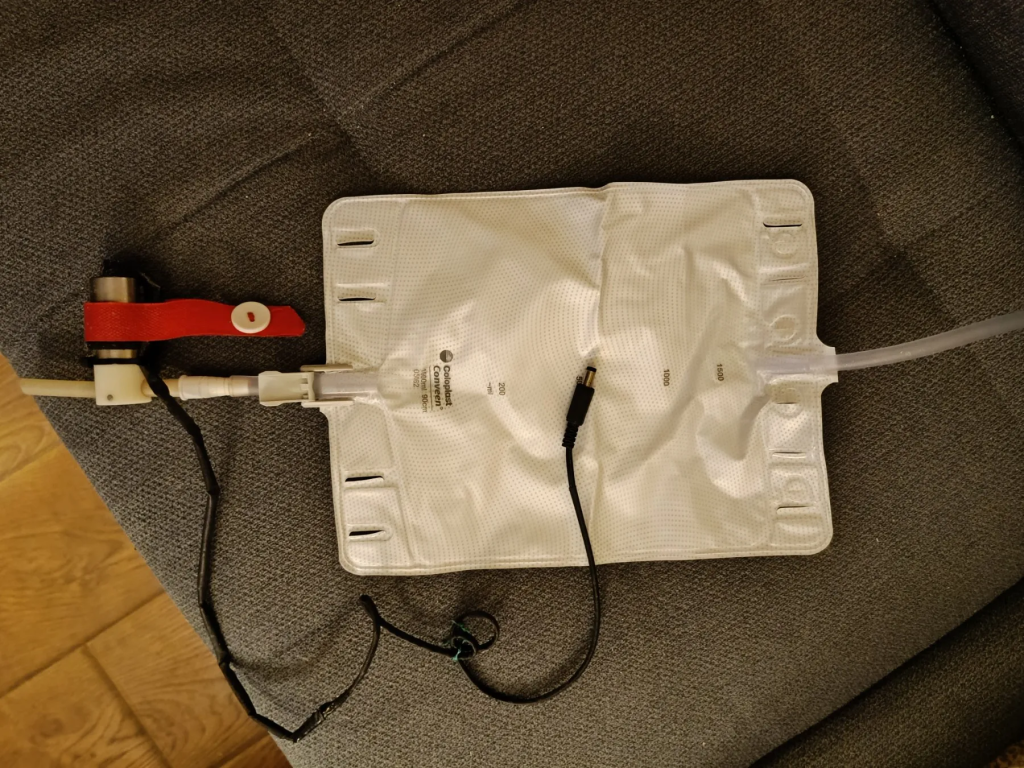
“I see it as an essential everyday tool—something every one of us should have, especially if you’re going out for several hours. With this device, I no longer depend on someone else to manually empty the urine bag when it’s full. Now I can do it myself, with the press of a button, wherever and whenever I need to. People who are in my situation—or something similar—will understand just how freeing and relieving that is,” Đorđe emphasized.
Read more at the link.
Phone Holder for Bed Use
Đorđe also created a phone holder by repurposing a microphone stand.
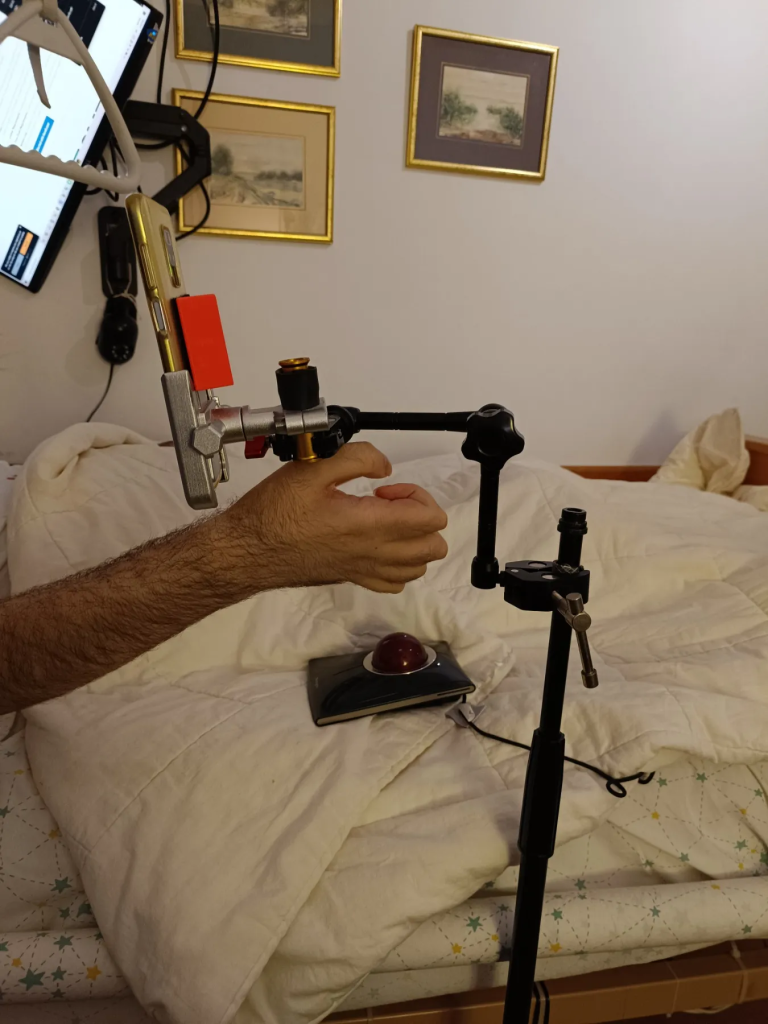
“I use it while I’m lying in bed. It’s placed right next to me, within arm’s reach, so my phone is always close at hand,” Đorđe explained.
Read more at the link.
Toothbrushing System for People with Minimal Arm Mobility
Regarding this system, Đorđe emphasized that it’s a carefully designed setup that allows a person with just a small movement of the arm, to cover all the directions needed for an electric toothbrush to reach every side of the teeth.
“The advantage of this kind of assistive device is that you have the freedom to brush your teeth whenever you want. You don’t need anyone to hold the toothbrush for you. The only thing that matters is that the system is fixed in front of you, where you can reach it, with the brush already positioned. I’ll be sharing more details and videos on my website soon,” he said.
Shaving System for People with Minimal Arm Mobility
“We all know how complicated shaving can be for someone with quadriplegia, you always need someone to do it for you. When I was younger, I used to shave a bit by using a special wrist support, but even that’s no longer possible. As we age, our arms get weaker,” Đorđe explained.
He added that this is precisely why he created all of these systems:
“As a kind of investment in the future, and a way to preserve a little dignity in life.”
He shared that the shaving system is something he has been working on for a long time.
“By using small precision motors and linear movements, the shaver can rotate at specific angles so the blade adjusts easily to the contours of the face and jaw.
This is a system I’ve been developing, modeling, and adjusting for a long time, and I finally hope it will perform as expected. Testing is in its final phase, and I’m looking forward to sharing a video demo soon,” Đorđe told us.
TURNIO – A System That Helps Immobile People Turn in Bed
TURNIO is Đorđe’s flagship project—a fully functional prototype he has been using for the past four years.
“It’s a system designed to make turning in bed easier for people who are immobile. This system restores dignity to a person’s life. It directly helps prevent pressure sores and relieves caregivers from the physical strain of manually turning the body. No more lifting, pulling, or rolling by hand.
Those who care for someone will immediately understand the value of this system. The risk of injury—for both the person lying in bed and the one doing the turning—is reduced to a minimum. And if the person can operate a remote control with their fingers, they can turn themselves whenever they want. They no longer have to wait for hours for someone to come help with turning or even small adjustments in bed position,” Đorđe emphasized.
He added that these are fundamental challenges faced by “an invisible army of immobile people and the true heroes who care for them.”
“This might be the most important thing I’ve created. It’s a system that sets a new standard for the care of immobile individuals,” Đorđe emphasized.
The Need for Collaboration and Support
Đorđe noted that support would be crucial for moving this important project forward.
“I’m currently at a stage where I need to produce several functional prototypes so the system can be tested in real-world conditions — either in people’s homes or healthcare institutions. The goal is to improve the system based on those tests and eventually make it commercially available for all who truly need this kind of support. This mission is deeply personal and meaningful to me, but I can’t do it alone.”
He explained that he needs assistance in multiple areas — from financial and technical support, through testing, to finding business partners who can help bring the product to market.
“The sooner we enter the implementation phase, the faster this system will be available to those whose health and quality of life it can significantly improve. As for intellectual property, the system has been submitted to the Intellectual Property Office of the Republic of Serbia. At the moment, I don’t have a technical collaborator who can help assemble the physical components, since I’m unable to do that myself due to my disability — which is also one of the reasons progress has been slower,” Đorđe said.
Bad Quad Cave — The Blog
Recently, Đorđe also launched a website — Bad Quad Cave, where he actively writes about his innovative solutions.
“I created the site around May this year. It happened somewhat spontaneously because I realized that nobody around here seemed to be working on the kinds of things I was developing — so I thought, why not publish them somewhere? Since I had already made several solutions, I slowly began writing about them and posting them online. People started reaching out, offering encouragement, and that gave me the motivation to keep going,” he shared.
He added that writing has now become an almost daily activity.
“The site can be a platform for others with similar challenges or interests. We can connect, collaborate, and create some amazing things. Anyone is welcome to reach out to me,” Đorđe concluded.

Be First to Comment